

Maple Grove Gazette - September 5, 2026
The mailbox war is over—John McGregor followed the getaway car by moonlight and caught the vandals red-handed. Plus loose geese, harvest labor, and a new mystery to solve in Tansy Ridge.
Maple Grove's Only Newspaper of Record—Vol. 1 No. 21—Edited by Mr. Ellison, Town Archivist & Historian
FROM THE EDITOR'S DESK
After a week that began with a school bulldog loose on the football field and ended with an actual criminal pursuit conducted by a private citizen in a personal pickup truck, this editor finds himself once again noting that Maple Grove's capacity for incident does not appear to be diminishing with the season. Readers who have followed the County Road mailbox matter since July will be glad to hear—this editor is glad himself, and admits it plainly—that this week's report contains an ending.
The particulars, as this editor has been given them: geese. Mr. McGregor spent a recent afternoon in the barn drafting what he calls "a permanent solution" to a goose problem that has plagued the farm's east pasture since spring, a project made more urgent by an incident earlier that same day in which their daughter Jenna’s dog, Biscuit, required rescue from a goose he had badly underestimated. It was after dark when Mr. McGregor walked back from the barn and heard voices at the end of his driveway, and beneath them, a sound this editor is told is best described as thwacking.
What followed, this editor reports without embellishment, because none is required. Mr. McGregor did not call out. He returned to his truck, and by the time the car at the end of his drive had pulled away, he was behind it—headlights off, the moon judged sufficient, the taillights ahead judged sufficient. He held back through a mile or two of County Road, through a crossroads, and onto a driveway of a fellow farmer. He did not go in blind. He waited until the car's occupants were out and standing in the open before switching his headlights on.
This editor is told the resulting scene involved three young men, ages seventeen, fifteen, and thirteen, several urgent requests that Mr. McGregor lower his voice on account of their sleeping parents, and a flat refusal. The parents were roused; the mother, by all accounts, was appalled. The father required no assistance from Mr. McGregor in expressing his own views, which this editor understands were extensive, and which Mr. McGregor allowed to run their full course without interruption. Mrs. McGregor, informed over coffee the next morning, said only that she wasn't surprised, and asked whether he'd remembered to feed Biscuit. By eight o'clock the following morning, three boys were on the McGregor porch with a new mailbox and the tools to install it. Per their father's instruction, they will be reporting to the McGregor farm every afternoon and weekend through the end of harvest. chief Carter has been informed of the situation and is in full agreement regarding atonement.
By Tuesday, the story had reached the diner, which this editor understands is the only venue in town where a true account improves with retelling rather than the reverse. Mr. McGregor's truck, in the earliest versions, followed the car a mile or two down County Road; by Wednesday the distance had grown to "the better part of ten miles"; by Friday, at least one telling had him making the entire run without headlights, moon or no moon, and pulling in behind them one-handed. This editor spoke to Mr. McGregor directly and can report the true distance was closer to two miles, the headlights came on well before the confrontation, and both of his hands, throughout, remained where the manufacturer intended. Mr. McGregor declined to correct the diner's version. This editor suspects he has earned the right.
📜 POLICE BLOTTER
MAPLE GROVE POLICE DEPARTMENT—INCIDENT REPORT
Reporting Officer: Officer Wilson Week of: August 29 -September 4
County Road—Property Damage, Case Closed. This department's open file on the County Road mailbox incidents, opened in July, is closed as of this week—not, Chief Carter wished it noted, through any action of this department. "We weren't consulted," the Chief said, "and having reviewed how it came out, we don't have a complaint." No charges were filed; restitution was arranged privately between the families involved. Final Disposition: Closed. File transferred to archive.
📋 COMMUNITY NOTICES
Loose Geese—County Road, East Pasture. Motorists and walkers are advised the geese remain at large pending completion of Mr. McGregor's pen, expected "any week now." Cyclists in particular are encouraged to give the shoulder a wide berth.
Farm Help Wanted—Filled. The McGregor farm's need for weekend and afternoon labor through November has been resolved via private arrangement. No further applicants necessary.
Fall Farmers Market—Saturdays through October, 9:00 a.m. to noon, the green. Vendors report a strong tomato year and an unusually competitive pumpkin bracket already forming ahead of the October weigh-in.
🏛️ HISTORICAL NOTE
This editor, in the course of closing the McGregor file, took the opportunity to review the mailbox folder in full rather than merely its recent contents, and reports the result with some surprise. The folder's oldest clipping is dated 1958: a Gazette item reporting that three county boys had been apprehended for what the article calls "the wanton and repeated destruction of United States mail receptacles by means of a Louisville Slugger," at what this editor gathers was roughly the moment newly licensed teenage drivers and newly standardized rural mailboxes first arrived at the same conclusion about each other, nationally, at once. The practice, in other words, is not new. This editor offers the historical record without further comment, except to note that the Gazette of 1958 used a great many more words to say a great deal less than this editor has managed above.
🔍 Fellow Sleuths Worth Following
This week I'm sending you down to Tansy Ridge, where the lake is calm and absolutely nothing else is. Fellow sleuths, meet Daphne Cole.
Murder Makes Ripples by Cora Finch drops a true-crime podcaster into the middle of Lake Days week, has him dead within a day, and points every piece of evidence at the town sheriff. Daphne—bookstore café owner, one very large Old English Sheepdog named Mooney at her side—isn't buying it. Neither will you.
FREE READS—SEPTEMBER TITLES
Back-to-school chaos calls for something you can pick up and put down without losing the thread. This month's free shelf has you covered.
Browse September’s Free Books →
🍽️ THE MAIN COURSE
Every September I get the same question: where do I start? Right here. Scones, Secrets, and Sabotage is Book 1, it's free, and it's the reason Jenna McGregor ever got tangled up with murder in the first place—a spilled bag of flour, a body in the pantry, and a golden retriever who is somehow already a suspect. If your afternoons have gone the way mine have this month—snack, backpack, one more load of laundry, repeat—this is the book that fits in the cracks. Start reading free →
✍️ Behind the Scenes
My granddaughters are still adjusting to the school-year schedule. All summer they stayed up too late, and now that the bus comes before 6 a.m., they arrive at my house every afternoon half-asleep, and I've spent the week feeding them a snack while they blink their way back to consciousness. No homework yet, so we've got a little runway before the real test hits. Also: the dishwasher died this week. We're replacing it this weekend. That's the whole report.
See you next Saturday, fellow sleuths—same town, new trouble.
— Willow 🌿







Meet Willow
Author, School Board member, and gluten-free baker. I write the Jenna McGregor mysteries from my home in Michigan, fueled by coffee and Peloton PRs.
Want to stay in the know? Get the Weekly Gazette

Maple Grove Gazette - August 29, 2026
A string of firecrackers emptied the bleachers, the school bulldog went through the band at knee height with his leash trailing, and the low brass went down like dominoes. Then Maple Grove won it on a Hail Mary. Plus a bus stop, a boy in one shoe, and an archive that has been keeping count.
Maple Grove's Only Newspaper of Record—Vol. 1 No. 20—Edited by Mr. Ellison, Town Archivist & Historian
FROM THE EDITOR'S DESK
The district opened Tuesday, and the town discovered what it discovers every year, which is that a child who has spent eleven weeks going to bed when he felt like it does not become a scholar overnight, or by Thursday. This editor took his morning walk past three separate bus stops and can report the following. At the first, four children stood in a line as straight as a fence and did not speak. At the second, a boy of perhaps nine sat down on the curb with his backpack still on and closed his eyes, and his sister let him, and neither of them said a word about it. At the third, a young man had come out in one shoe. He was aware of it. He had made a decision.
The parents divide, as they always divide, into two nations. The first is at war and losing. This editor has heard the same sentence from four mothers in six days, in four different aisles of the same grocery, delivered each time in the tone of a woman reporting from a front: he was up until eleven all summer and I let him. They are not asking for sympathy. They are entering it into the record.
The second nation was seated at Brewed Awakenings by five past eight on Tuesday morning, dressed, and had been for some minutes. The café reports that the long table by the window was full at 8:05 and did not turn over until nearly ten, and that the conversation at it was conducted at a volume the crew had not heard since the second week of June. Jenna made no remark about the volume. She did put a second pot on at ten minutes to eight, which she does not ordinarily do on a Tuesday, and which this editor takes as a form of comment.
The first home football game of the season was played Friday evening against Cooper's Creek, under a sky that had finally consented to be cool, and it will be talked about in this town for thirty years. It began exactly as these things begin. The band took the field for the pre-game under Mr. Robinson and played it clean. The teams came out. The anthem was sung. The ball was kicked. For one half of football the evening was an ordinary evening, and this editor records that plainly, because nothing after it was ordinary and the contrast is the whole of the story.
At halftime the band took the field again with the cheer squad, and somewhere in the sixth or seventh minute of the performance there was a string of reports from behind the visitors' bleachers, close together and loud, that stopped the trumpets mid-phrase.
The stands emptied. They emptied the way stands empty when nobody yet knows what a sound was, which is quickly and without much dignity and with a good many people carrying somebody else's coat. It was firecrackers. It was firecrackers within about ninety seconds, once the Chief had gone behind the bleachers and come back out and said so, and the crowd came back the way a crowd comes back, sheepish and loud and telling each other where they had been standing.
Winston III did not know it was firecrackers. He took advantage of his handler's flinch, took off with his leash trailing behind him—and he went into the band.
He was not moving fast. This editor wishes that understood, because every account since Friday has him streaking, and he has never streaked in his life. He was moving low and he was moving with purpose and he did not go around anything. He took the tuba out at the back of the knees. What followed has been described to this editor by nine separate residents as dominoes, which is the correct word and this editor will not improve on it. The low brass went down in order. Nobody was hurt. One sousaphone bell requires Mr. Robinson's personal attention, which it has already received, and which he describes as "not the first time."
Winston III was then at large on the field for eleven minutes, and the Gazette wishes to correct the record on that as well. He was not being chased so much as approached. The stands were empty by then; the only people available were the band and the cheer squad, who had been standing in the middle of it and had nowhere to go. Fifty-odd young people in uniform closed on a fifty-five-pound dog at walking speed for a quarter of an hour and could not lay a hand on him. He was never once out of reach. He was simply never where the reaching was. He was stopped near the north end zone by a woman in her sixties who did not chase him at all. She stood where he was going to be, put a foot on the trailing leash, and bent down and picked it up. She handed it to his handler, said something to the young man that this editor was too far off to hear and that the young man has since declined to repeat, and left before anybody thought to thank her. This editor did not recognize her and has not been able to identify her since.
Chief Carter and Officer Markle were on the grounds, as they are for every home game, and had the matter behind the bleachers settled before the dog was. They found two young men and the remains of what the department's report calls, with restraint, a quantity. The young men were Wesley and Merritt Ellison, aged fifteen and thirteen. Readers who have followed the department's acquaintance with those two will not be surprised, and this editor notes only that the acquaintance is not new and that the park was, on the previous occasion, at least empty.
The Gazette discloses, because the record requires it and because there is not a person in this town who does not already know it, that the young men's father is this editor's nephew. Their names are both on the 1887 plat, several times over, which this editor has always regarded as an honor and regarded on Friday evening as something else.
They were taken to the station. Their father, Thomas Ellison, arrived within four minutes, which suggests to this editor either an unusual turn of speed or a certain readiness. Asked by the Chief what he wanted done, Thomas said he wanted them kept overnight. The Chief, who has known the family a long while and who has also met a thirteen-year-old, proposed forty hours of community service instead. Thomas considered this and said it was not enough. The Chief said it would do. The boys begin Monday after school under Officer Sanchez, who has a list, and who has had the list for some time.
The game resumed. It stayed level through the third quarter and most of the fourth—twenty-one apiece, under a minute on the clock, and Maple Grove ninety yards from anywhere it needed to be. What happened next is already being told wrong in four places, so the Gazette will set it down once, correctly, from the press box.
Tyler Baker threw it. He is a junior. He threw it from his own thirty-two with the clock inside forty seconds and he threw it as far as he could throw it, which is the only honest way to describe the play. Sam Hemlock came down with it in a crowd at the goal line, and this editor, who has watched this field since before either boy's father was born, does not know how. The extra point was good. Cooper's Creek fumbled the kickoff return, Maple Grove fell on it, and that was the evening.
The older men at the diner spent Saturday morning observing that Baker's father played, and played that same position, and was not as accurate. Old Man Hemlock observed nothing. He sat at the counter and let other people bring it up, which they did, eleven times, and he received each one as though it were news. Shirley reports that he stayed past ten and did not once look at his watch.
📜 POLICE BLOTTER
MAPLE GROVE POLICE DEPARTMENT—INCIDENT REPORT
Reporting Officer: Officer Markle Week of: August 22–28
Tuesday, 7:40 a.m., the streets nearest the elementary building. The department received four complaints in eighteen minutes regarding vehicles stopped in the roadway. In every case the vehicle was a parent's, the roadway was the drop-off lane, and the delay was occasioned by a child who would not get out. Two officers attended. No enforcement action was taken or contemplated. Final Disposition: The department reminds residents that the drop-off lane is a lane. It further notes that this is the twelfth consecutive year it has reminded them.
Friday, approximately 8:38 p.m., behind the visitors' bleachers, the high school field. The department responded to a report of an explosion. The responding officers determined within two minutes that the source was commercial firecrackers, discharged in quantity, and the Chief communicated that determination to the crowd from the track. Two juveniles were located at the scene and transported to the station, where both were released to a parent the same evening. In consultation with the father, the Chief imposed forty hours of community service in lieu of further action, to commence Monday, September 1, under the supervision of Officer Sanchez. Final Disposition: No charges filed. The department notes that both young men were cooperative, that both were forthcoming as to method, and that one of them was, in the reporting officer's assessment, somewhat proud of the method.
Friday, approximately 8:39 p.m., the high school field. An animal at large. The animal was Winston III. He was at large approximately eleven minutes and was recovered without injury to himself or any person. Contact was made with one member of the band program at the level of the lower leg. The department records that the animal did not leave the field at any point, was at no time in danger from traffic, and was at no time in excess of a walk. Final Disposition: Animal returned to the custody of the school. The department has no recommendation as to leashes, grip, or the reflexes of a fifteen-year-old, and has now been asked for one six times.
County Road. For a third consecutive week, nothing. The mailbox at the McGregor farm stands. Cheryl reports it is the only box on that road she can serve without slowing below fifteen, the height and the setback being, in her professional judgment, exactly correct, and she wishes the rest of County Road to understand that this was not an accident and that she notices.
Chief Carter was asked Saturday morning whether Friday's matter behind the bleachers bore on the matter on County Road. The Chief said it did not. Asked whether he was certain, he said that he had been doing this a long time, that one of the young men in question was thirteen years old, and that whoever is out on County Road at two in the morning is not thirteen and is not practicing. He then said the department had nothing further on it. This editor prints the exchange as given.
📋 COMMUNITY NOTICES
Schools—first week. The district opened Tuesday. The office reports attendance at ninety-six percent Tuesday, ninety-four Wednesday, and asks that the town read nothing into Wednesday.
Bus stops. The transportation office asks that children be at the stop five minutes early. Arriving as the bus is pulling away from the stop is not ‘on time’, and notes the distinction is not rhetorical. Drivers report they are holding for no one after the second week. They have reported this every year. They have held every year.
Brewed Awakenings—extended hours. The café is open until ten Tuesday through Saturday for the term, the college having returned and the studying with it. The fall board is up: the Autumn Alignment stays, still at two per customer per day, joined by a maple cream cold brew and a spiced apple scone this editor is not in a position to evaluate at this hour of the morning but intends to be. Megan notes that the late hours are staffed entirely by students, that the students in question are the reason the late hours exist, and that she considers the arrangement fair.
Maple Grove College—welcome week. Welcome week concluded Sunday and was, by the college's account and the town's, well attended. The Provost wants to remind the community that they are welcome to use the library on campus any time between 9 and 5 Monday through Friday and 11 to 6 on Saturday.
Community service—work available. Officer Sanchez advises that he has forty hours of labor to place beginning Monday and welcomes suggestions. The Ladies' Auxiliary submitted three before he finished the sentence. The Gazette understands that the cemetery association has also written, that Gordon has a gutter, and that the department will be prioritizing.
Winston III. The athletic department reports Winston III uninjured, unbothered, and eating. It wishes it understood that the collar held, that the collar has never been the difficulty, and that a bulldog's head does not permit the collar to be the difficulty. The difficulty was six feet of leather in the hand of a boy who had just heard the same noise everybody else in the stadium had heard. The department has been asked to recommend a different arrangement and has declined, on the grounds that it can think of nothing to recommend except that nobody set off firecrackers behind the bleachers, which it had assumed went without saying. He is on loan to the school Friday nights and lives the rest of the week on Third Street, where he is reported to have slept through Saturday.
Band. Mr. Robinson thanks the low brass for its composure and asks the town not to make more of Friday than Friday deserves. He would like it known that the sousaphone is repairable, that it is not that instrument's first difficulty, and that the young man carrying it was back at practice Monday and is fine.
🏛️ HISTORICAL NOTE
The archive holds a folder labeled Mascot, and it is a thin folder for a subject this town has strong feelings about.
The school's position is that Winston III is the third Winston. The school states this in the program, has stated it for years, and has never been asked to defend it.
The Gazette's photographic record shows that this school has kept a bulldog since 1951, that eleven distinct animals appear in the pictures, and that eight of them were called Winston.
This editor spent a portion of Sunday satisfied that the school was wrong and the remainder of it discovering that it is not. The school is not counting the dogs. It is counting the ones that have come from the Harper place, and it began counting in 1994, when the first of them did. Nobody at the school was able to explain this to the Gazette. Everybody at the school does it correctly.
Two generations of that family have kept Winston now. He is not a school animal and never has been; he lives at the Harpers', eats at the Harpers', and sleeps, this editor is given to understand, wherever he has decided to. On Friday evenings the family walks him down to the gate and hands him off, and afterward they take him home again, and that is the whole of the arrangement. There is no contract. There has never been a contract.
What the folder does establish is the office of the Keeper, which is a student position, unpaid, appointed by the athletic department, and older than any faculty member now living. The Keeper leads Winston onto the field, holds him through the anthem, and secures him for the half. It goes to a Harper when there is a Harper of the right age, and the file shows several. There is not one at present—the eldest of that household is six—so it has gone this year, as it has gone in other lean stretches, to an appointed student, who took it seriously, and who had it for two games.
Fifty-odd names are in the file. Not one belonged to a young person who was also on the football roster that year. The archive gives no reason for this. The archive does not have to.
The archive is also able to state, from the attendance photographs and from nothing else, that in all the years it has been keeping them, there is no home football game at which that family is not somewhere in the frame.
The folder also holds a short list, kept by somebody, of occasions on which a school bulldog has been at large during a home game. Friday was the fourth. The dates are 1958, 1971, 1994, and 2026, and the entries grow shorter as they go, which this editor reads as the record of a town that has stopped being surprised.
One detail appears in all four, in three different hands. The animal was caught by a woman.
The 1958 entry names her. The 1971 entry does not. The 1994 entry says only a lady up in the north bleachers, gone before anyone got her name.
This editor offers the historical record without further comment.
🔍 Fellow Sleuths Worth Following
A Taste for Deadly Secrets by Tessa Crumb. Maisie Brooks comes back to Meadow Creek to take over her late grandmother's café, braced for gossip and a steep learning curve, and instead gets a blind date who never shows—because he's already dead, in what everyone official is very comfortable calling an accident. Maisie is not comfortable with it. What she has going for her is a good eye, a loyal dog, and an old friend willing to be dragged into it. What she's up against is a defensive girlfriend, a sheriff who wants this closed a little too much, and a town whose picture-perfect surface starts showing cracks the moment somebody looks straight at it. If you like a café sleuth who notices the thing everyone else has quietly agreed not to notice, this one's for you.
FREE READS—AUGUST TITLES
Last call on Willow's August free books—the page turns over Tuesday, and a few of these are only free through the weekend. Grab what looks good while the porch is still warm enough to read on.
Help yourself: Browse August’s Free Books →
🍽️ THE MAIN COURSE
If you read this week's Blotter and thought wait, the department knows those boys—you're right, and there's a book about it.
Parade of Peril is the Maple Grove book where the town throws its fall festival and the fall festival throws something back. It opens with a childhood bully posed in a field like a scarecrow, which would be shocking anywhere and is worse here, because Jenna knew him. Then there's a second body on a parade float parked behind her own café. And running along the edges of all of it, in the park after dark, are a couple of kids with considerably more access to fireworks than sense—the kind of detail that reads like background right up until it doesn't.
This is the book where Maple Grove's past stops being a nice thing the town tells itself. Everybody Jenna went to school with turns out to be a person with a version of events, and the versions don't match, and Joe would very much like her to stop collecting them. She does not stop collecting them.
It's the fall book. It's the one for the stretch where the evenings get shorter and the festival tents go up.
New to Maple Grove? Start at the beginning—Book 1, Scones, Secrets & Sabotage, is free →
✍️ Behind the Scenes
School starts Monday here, so we spent the last of the week doing the things you do when you can feel a season closing—day trips, no particular agenda, everybody in one vehicle. My oldest granddaughter starts fifth grade, and with it, band. She has chosen the clarinet. I would like it on the record that her mother, both her aunts, and her uncle came through this house with a trumpet, a saxophone, and a full drum set between them, and that I have therefore earned the clarinet and intend to enjoy every minute of it. The garden's winding down too, so I've been pulling what's finished and hauling it out to the compost heap, which is the least glamorous job of the year and somehow one of my favorites—October goes a great deal easier when September did the work. And Luca started daycare this week. His dad had braced himself for tears and got a backwards wave instead, and has not entirely recovered.
See you next Saturday, fellow sleuths—same town, new trouble.
— Willow 🌿
Meet Willow
Author, School Board member, and gluten-free baker. I write the Jenna McGregor mysteries from my home in Michigan, fueled by coffee and Peloton PRs.
Want to stay in the know? Get the Weekly Gazette
Maple Grove Gazette - August 122, 2026
Three thousand students arrived on one Saturday, and the busiest corner in town is a four-way stop. It was held for four hours by a man in a vest nobody issued him. Plus an autumn alignment at the café, two urns of lemonade, and a sofa nobody will claim.
Maple Grove's Only Newspaper of Record—Vol. 1 No. 19—Edited by Mr. Ellison, Town Archivist & Historian
FROM THE EDITOR'S DESK
The college officially moved in on Saturday, and it moved in all at once. Last week's students were a vanguard—the early, the eager, and the ones whose fathers wanted the drive over with. Saturday was the rest of them. They came from the state road in a line that did not break between half past eight and something after one, in cars packed to the roofline and rented trucks packed past sense, and every one of them arrived at the same four streets. The college's own figure is thirty-one hundred and something, given to this editor with the caution that it is not final until the second week and never has been. Whatever it settles at, the town felt it. The line at the diner ran out the door at eleven in the morning, which it does not do on a Saturday, and Belle reports selling four lamps, two mirrors, and a wardrobe before noon to people who had come in only to use the restroom.
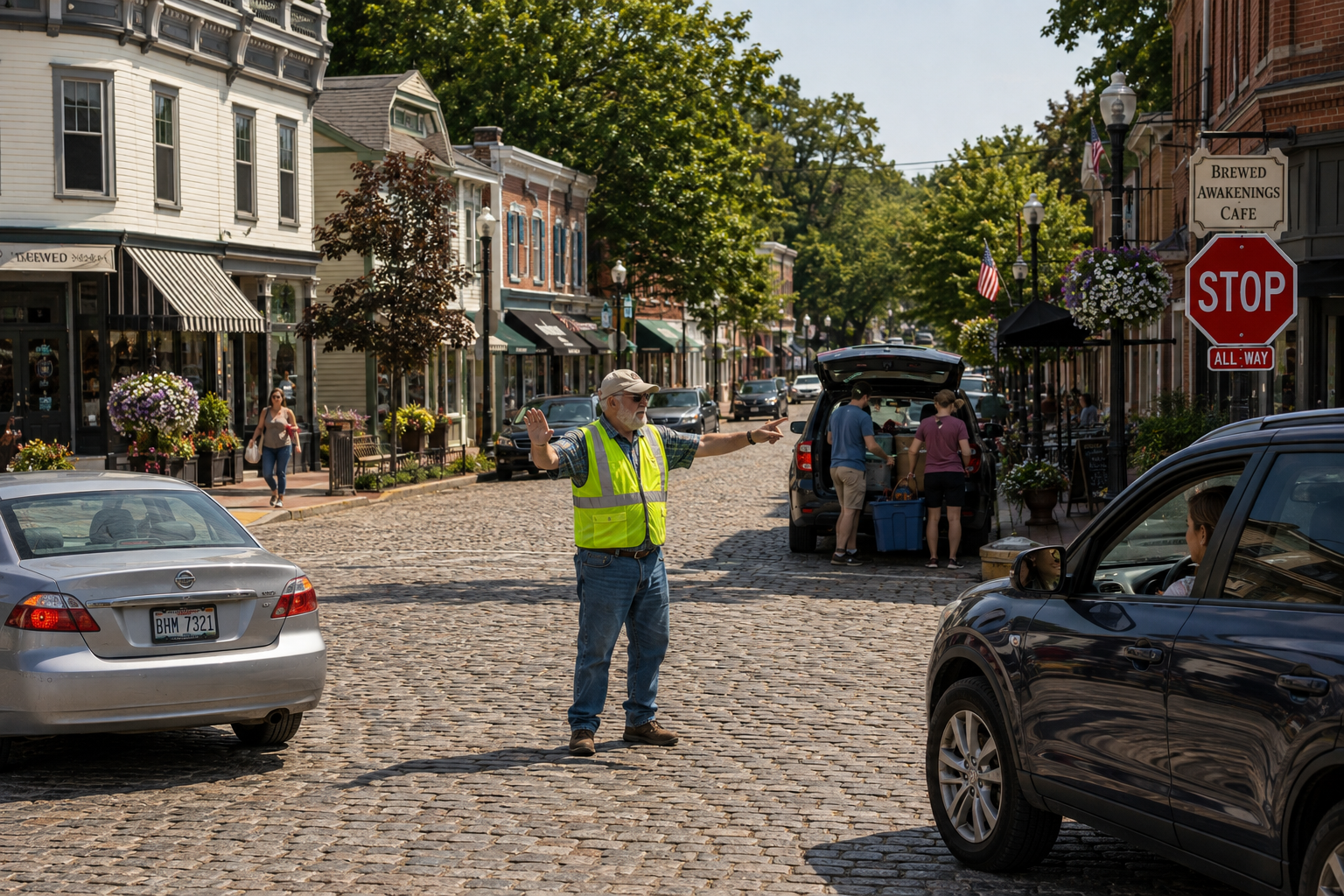
Maple Grove has no traffic signal and never has had one. What it has is a four-way stop at the corner where the state road becomes Main, and a four-way stop is not a piece of equipment. It is an agreement. It functions because the people using it know one another, know the corner, and take their turns without being told. It does not function when several hundred vehicles arrive from out of the county inside of three hours, every one of them wanting to turn left across traffic into the same two blocks, and not one of them with any idea whose turn it is. By nine o'clock the agreement had become a standoff. Cars sat at the stop while six and eight vehicles went by in front of them without a gap. A gentleman from out of the county, waiting to make that left, was heard to observe that somebody ought to do something.
Somebody did. At approximately nine fifteen, Wendell Fitch walked out from the sidewalk into the middle of the intersection wearing a reflective vest and began directing traffic. He was not asked to. He is not employed by the village in any capacity, holds no office, and has no standing whatsoever in the matter. He is, on the other hand, the man who read the Declaration through in the July storm without once lowering his voice, and it did not occur to a single driver to question him. He worked the intersection until half past one. He moved the left turns in blocks of eight. He held the state road when it needed holding and let it go when it did not, and he did all of it without a whistle, a cone, or any apparent difficulty. Traffic cleared by twenty of ten and stayed cleared.
Chief Carter arrived at approximately nine forty, parked at the curb, and got out. He stood by his vehicle for some minutes with his arms folded. He then got back in his vehicle and left. Asked afterward whether the department had authorized the arrangement, the Chief said that it had not. Asked whether he had considered ending it, he said that he had considered it. Asked what had stopped him, he said, "He was doing it right." This editor prints the exchange in full and directs the reader's attention to this week's Historical Note.
At Brewed Awakenings, meanwhile, the crew has been under the kind of pressure the café ordinarily sees only in the second week of September, and Lisa has taken steps. On Sunday evening, after closing, she performed what she describes as an autumn alignment—a seasonal correction of the room's energy, undertaken, she says, because a café carrying this many people cannot be expected to carry them well if the flow is running against itself. The particulars involved the moving of two tables, the repositioning of the coffee station, the opening of a window that has not been opened since the spring, and a period of some length during which she stood in the middle of the floor with her eyes shut. Jenna permitted all of it, this editor is told, on the express condition that nothing be lit.
The line has moved faster every day this week. This is not in dispute; it is the plain observation of everybody who has stood in it. The town has drawn its conclusion and the conclusion is Lisa, who has been thanked in the street twice and has accepted both times with what this editor can only call grace.
At the table by the window on Thursday morning, Gordon asked the room in general whether anyone else could feel the difference. Belle allowed that it did seem lighter in there. Mildred said that the espresso machine had been moved. The table then returned to the subject it had been on, which was the sofa.
The Gazette adds the following for the completeness of the record. On Sunday evening, after the alignment and after Lisa had gone home, Jenna moved the espresso machine from the middle of the counter to the far end of it and put the second register back into service. She mentioned it to nobody. Asked about it Thursday, she said it had needed doing since June.
Asked whether the alignment had made any difference, she said she was not going to answer that. Asked about the window, she said the same.
📜 POLICE BLOTTER
MAPLE GROVE POLICE DEPARTMENT—INCIDENT REPORT
Reporting Officer: Officer Wilson Week of: August 15–21
Saturday, 8:00 a.m., alley behind the 100 block of Main. The department received a report of a rented moving truck stopped in the alley and blocking it entirely. The driver, a parent from out of the county, had entered the alley in order to unload nearer the rear stairs of an upstairs apartment, and had discovered some sixty feet in that the alley narrows. He was unable to continue and unable to reverse, three vehicles having queued behind him in the interval. The responding officer cleared the three vehicles in turn. Two drivers were located promptly. The third was located after twenty-five minutes, at the counter of Brewed Awakenings, waiting on an order. The truck was reversed out of the alley by the officer at the driver's request and with the driver's stated relief. No damage to the truck, the buildings, or the alley. Final Disposition: No citation. The department reminds residents that the alley behind the 100 block is posted at nine feet and that the posting is not an estimate.
Saturday, 9:15 a.m. to 1:30 p.m., Main at the state road. An individual not employed by or affiliated with this department directed traffic at the intersection for a period of approximately four hours and fifteen minutes. The individual was Mr. Wendell Fitch. He was wearing a reflective vest, which he owns. The responding officer attended the scene at 9:40 a.m., observed the intersection for a period, and did not intervene. The department notes that traffic cleared, that no collision, complaint, or injury arose at the intersection during the period in question, and that the department received no calls to it at all after 9:50 a.m. Final Disposition: No action taken.
Sunday, various, the boulevard. A sofa appeared. The department has been unable to determine when, by whom, or from where. It is brown. It has been reported to the department four times, in every case by a resident who wished it known that it was not theirs. The department has no ordinance to bring against a sofa on the boulevard and does not intend to invent one. It observes only that as of Wednesday evening the sofa had been sat upon.
County Road. For a second consecutive week, the department reports nothing. The mailbox at the McGregor farm stands. Mr. McGregor has taken the blind out of the brush and returned it to the shed, which the town noticed within a day and has been discussing since. Asked at the diner whether he had given the matter up, he said that he had not given anything up, that a man cannot sit in a field indefinitely, and that he sleeps light and the window faces the road. The counter took this as a reassurance. This editor is less certain that it was one.
Chief Carter, asked to comment on the week generally, said that several thousand young people arriving in one morning had gone considerably better than a normal Fourth of July. Asked whether he was pleased, he said he was. Asked whether he intended to put any arrangement in place for next August, he said that the town had had an arrangement since 1969 and that he was not going to be the one to change it.
📋 COMMUNITY NOTICES
Main Street parking. The two-hour spaces are enforced again as of Monday. The department reports that the majority of last week's chalk went on out-of-county plates and that most of those drivers have gone home. Residents are asked to leave the spaces nearest the shops for the shops.
Brewed Awakenings—new on the board. The café has added a drink for the season, named by Lisa: the Autumn Alignment. There has been considerable speculation about what is in it. The board carries a limit of two per customer per day, which was posted on the second morning and which was not Lisa's idea. The Gazette is informed that the limit is being met with organization, and that students who have already had their two have begun arriving in the company of roommates who do not drink coffee.
Ladies' Auxiliary luncheon. The Auxiliary hosted its luncheon for the district's teachers on the day they reported back to their classrooms, and set out casseroles, salads, and a dessert table this editor is told was the equal of any in recent memory. A life-long resident of this community, known to every reader by her preference for a loud floral print, delivered two large urns of homemade lemonade. The first several servings produced a reaction at the drink table that this editor will describe only as immediate. It was afterward established that the resident in question had reached for salt rather than sugar and had not tasted the result before loading the urns into her car. The Gazette declines to name her. The Gazette does record that a first-year teacher, seated nearest the urns and unwilling to give offense, finished her entire glass.
College—first week of classes. Classes began Monday. The library has returned to term hours and the college asks that the town be aware the reading room is open to residents, as it is every year, and as it is used every year by four people.
Schools—first day. The district opens Tuesday. The office asks that any family still needing to register do it Monday afternoon rather than Tuesday morning, and observes that this request has been made every August for as long as there has been an office to make it.
Band practice. Mr. Robinson's marchers have worked mornings all month while the heat held. The heat broke Sunday, and practice moves to evenings once classes begin. He wishes it known that the section responsible for last week's noise complaint has been addressed, and that the town need not worry about further disturbances.
The sofa. The department has asked the Gazette to state that it is not looking for the owner of the sofa, that it has not at any point been looking for the owner of the sofa, and that residents may stop telephoning to say it is not theirs. A lamp appeared beside it Thursday. The department is not looking for the owner of the lamp either.
🏛️ HISTORICAL NOTE
The archive holds a folder on the college that is thicker than the college's own, for the reason that the college keeps records of itself and the town keeps records of what the college does to it. The two are not the same document.
The relevant entry this week is from the autumn of 1968, and it is titled, in the Council's own hand, "Plan for the Orderly Reception of Students."
The Village Council of that year, having endured several Septembers, appointed a committee. The committee met four times.
It is worth stating plainly what a Village Council can and cannot do. The Council governs four streets, a boulevard, and the corner. It does not govern the college. It has never governed the college, has no standing on that ground, and could not tell the college what hour to open its gates if it wished to. What the committee produced was therefore a plan for the village half of a problem the village owned half of: a one-way routing of the four principal streets, a designated approach and a designated departure, and a diagram. The diagram was printed. The archive holds nine copies of it and the Gazette has examined all nine, which are identical, and none of which can be read.
The cards are a separate matter and a worse one. The committee had cards printed in four colors, on the reasoning that a family arriving with a card in hand would know which street to take. Having no enrollment list, and no means of obtaining one, the Council wrote to the college registrar in July and asked that the cards be included with the packets going out to incoming families. The archive holds the Council's letter. It does not hold a reply.
The plan was put into effect on a Saturday morning in September and abandoned at approximately eleven o'clock. The file does not give a reason for the abandonment. It gives instead a letter from the fire chief, who was unable to bring a vehicle up Main from either direction for a period he estimated at forty minutes, and who wrote that he had no criticism to make of the committee, that he was sure the members had done their best, and that he would like it noted that he had asked to be consulted in March and had not been. The Council's minutes for October record that the plan was retired, that the cards were to be kept in case a use was found for them, and that the matter was closed.
The minutes for November record one further action. The Council petitioned the county for a traffic signal at the corner. The county replied in February that the traffic counts did not support the installation of a signal. The county takes its counts on the state road, where the college keeps its own entrance and where the great majority of that traffic has always gone; it does not take them at the corner, on the four mornings a year when the corner is the only thing that matters. This has been explained to the Council in writing on four occasions. The archive holds all four letters, which are, apart from the date and the signature, the same letter.
The file records what happened the following September, which was nothing. No committee was appointed. No plan was drawn. Traffic backed up at the corner where the state road becomes Main, as it always had, and at some point in the morning a man walked out into the intersection and began directing it, and by noon it was clear. The clerk who kept the minutes that year noted the fact in a single line and did not give the man's name, apparently on the view that it was not a Council matter.
The archive has the name for every year since 1974, when the Gazette began printing a photograph. It is not always the same name. It is the same name a great deal more often than chance would explain. The file also holds a Council motion from 1981 proposing that the village issue the gentleman a vest and an armband, in the interest of liability. The motion failed for want of a second, the Council having been advised—correctly, this editor believes—that the arrangement worked precisely because it was nobody's arrangement.
One further matter belongs in the record, since the reader will have noticed that this newspaper has spent several columns on September while everything else in this issue took place in August.
The college opened in September for the whole of the period this file covers. It does not now. The date has come forward by degrees over the intervening years—a week here, a few days there, every change sensible on its own terms and not one of them announced to anybody in this village. The college is under no obligation to announce it. The village has no standing to ask. The archive can date the drift at all only because the archive keeps the photographs. The one taken in 1974 was taken on the fourteenth of September. The one taken last Saturday was taken on the fifteenth of August.
Nobody was told. The town found out the way the town finds out most things, which is that the traffic arrived and there it was. The folder is still labeled September. This editor has left it that way.
The cards are still in the archive. They were never distributed, and on any honest reading of the file they never could have been. There are eleven thousand of them.
This editor offers the record without further comment.
🔍 Fellow Sleuths Worth Following
Deadly Deception in Willow Springs by Sloane Foster. Marnie Devlin moved to Willow Springs for a quiet second act and a vintage boutique, which lasted right up until a body turned up behind a wall in a Victorian manor. She's sixty-five, she has an encyclopedic memory for couture, and she cannot walk past a stray animal or an unanswered question. Helping: Ruby, who manages the shop and knows everybody's business a little before they do, and Taco, a very small dog with a very good nose. The suspects come fast—a niece positioned to inherit the dead man's job, a doctor who lost a fortune to forged art—and every one of them leads somewhere other than where it pointed. If your favorite cozies run on an older sleuth who's been underestimated her whole life, this is a Marnie Devlin mystery—and it's out today.
FREE READS—AUGUST TITLES
August Free Books are still live on the website through the end of the month—a last batch of free cozies for the stretch of August where the evenings finally cool off and the porch comes back into use.
Help yourself: Browse August’s Free Books →
🍽️ THE MAIN COURSE
The students came back to Maple Grove this week, which is the exact moment Book 3 starts.
Harvest of Shadows and Dark Brews opens with the town at its fullest and busiest and most pleased with itself. The college is back. The café is slammed. Everything in the township is ripening at once. And a group calling itself The Grove has taken a booth at the farmers market, where they sell produce that is a little too shiny and turn up at the hardware store once a week in robes to buy supplies. Everyone agrees they've been a real gift to this community.
There's a college student in it who ends up somewhere she has no business being. There's Professor Donovan, who has never once been as much help as he thinks he is. And there's a tonic that nobody at Brewed Awakenings can account for—not the ingredients, not the supplier, not how it got behind Jenna's counter—which is the point where the book quits being about produce.
Lisa is delighted by all of it. Lisa is the problem.
New to Maple Grove? Start at the beginning—Book 1, Scones, Secrets & Sabotage, is free →
✍️ Behind the Scenes
Summer's winding down here and we've been grabbing at the last of it—day trips, cookouts, anything that gets everybody in one place. This week it was breakfast out with my son and his family. The café was packed and the food was better than a town that size has any business serving: a bowl of roasted sweet potatoes under chorizo, an egg, avocado, and some kind of chipotle sauce I have been thinking about ever since. Luca cleared his entire kid's plate—pancakes, eggs, sausage—and then quietly annexed the rest of his dad's sausage and potatoes. The baby never made a sound—just sat there taking in the whole room, every table, the entire time, which is either excellent manners or the beginning of a detective, and I know which one I'm hoping for. See you next Saturday, fellow sleuths—same town, new trouble.
— Willow 🌿
Meet Willow
Author, School Board member, and gluten-free baker. I write the Jenna McGregor mysteries from my home in Michigan, fueled by coffee and Peloton PRs.
Want to stay in the know? Get the Weekly Gazette

Maple Grove Gazette - August 15, 2026
Five nights in a deer blind guarding the cheapest mailbox in the hardware store, and absolutely nothing happening. Plus every garden in town at once, no canning lids left at Gordon's, and a diner counter full of confessions.
Maple Grove's Only Newspaper of Record—Vol. 1 No. 18—Edited by Mr. Ellison, Town Archivist & Historian
FROM THE EDITOR'S DESK
August turned this week, as it does, without consulting anyone. The high school opened two-a-days Monday morning, and by Monday evening the town had its annual reminder that a whistle carries farther in August than in any other month of the year. The college opened camp the same week. The students began arriving ahead of classes—first in ones and twos, then in the manner of a tide—so that by Thursday the line at Brewed Awakenings had reacquired its September character and the café crew reports that the word "iced" is once again being used at volume. Both bands took to their practice fields, the high school under Mr. Robinson and the college under its own director, and residents living between the two report that on a still evening one may hear both at once, in different keys, working different formations, neither aware of the other. Mr. Robinson describes the arrangement as "not ideal." This editor notes that he was smiling when he said it.
The gardens, meanwhile, have done what gardens do. After a summer of arriving politely, one row at a time, the whole of Maple Grove's produce came on at once this week. Beans, corn, tomatoes, and peppers all came ready together, in quantity, and with no regard whatever for whether anybody had a free evening. The consequence was felt first at Gordon's, where the canning aisle was stripped to the shelf brackets by Tuesday afternoon. Gordon reports that he is out of lids, out of rings, out of pectin, and down to the wide-mouth jars that nobody wanted in June. He has begun a list. The list has thirty-one names on it. He observes, without elaboration, that it is the same thirty-one names every August, that he ordered heavily in July on exactly that expectation, and that it was not enough. Asked when more would arrive, he said: "Everything's coming. It's a question of when."
At the diner, the McGregor mailbox question has been taken up at the counter and shows no sign of being set down. Breakfast begins filling in around six, and by half past the counter is shoulder to shoulder and the two tables behind it are held, as they are held every morning, by men who have been drinking their coffee black in this town for fifty years and regard the arrangement as permanent. The conversation has run all week to the same two subjects in the same order: what ought to be done about the young people responsible for the ongoing mailbox crisis, and what the speaker himself got up to at that age. The first subject is disposed of quickly and with considerable vigor. The second takes longer. This editor, who takes his own coffee at the counter and hears a great deal more than he prints, can report that over four mornings the counter and the tables behind it condemned the vandals unanimously and then produced, with no apparent sense of contradiction, an account involving the water tower, an account involving the roof of the school, two accounts involving a certain tree and what is hanging in it, and one account that was stopped mid-sentence by the speaker's own brother. The Gazette draws no conclusions whatsoever. The Gazette does, however, direct the reader's attention to this week's Historical Note.
As for the McGregor farm itself, a new mailbox went up Monday. It is the least expensive box Gordon's Hardware sells—galvanized, standard size, the sort of thing a man buys without looking at it twice—and it stands on a plain metal stake set in ordinary dirt. After the hardwood barn, the welded rebar, and the events of the first week of August, the town had braced for something else entirely. Several residents have driven past twice to be certain. Asked about it at the diner, Mr. McGregor offered the first explanation he has offered on any subject since July: that he saw no sense in spending money on a mailbox while people were still destroying them, and that he would build a proper one when the matter was settled. This editor prints the remark as given, observing only that it was the first half of the sentence the town found reassuring and the second half it did not. What Mr. McGregor did instead is a matter for the Blotter.
📜 POLICE BLOTTER
MAPLE GROVE POLICE DEPARTMENT—INCIDENT REPORTReporting Officer: Officer Markle Week of: August 8–14
Tuesday, 10:52 p.m., County Road. The department received a report from a passing motorist of a person in camouflage in the brush at the edge of a field, some forty feet off the roadway, not moving. The responding officer located the individual without difficulty, the individual having stood up and said good evening. The individual was Mr. McGregor. He was seated in a portable deer blind, in full camouflage, in a sleeping bag of military issue and considerable age, with a thermos, a folding stool, and an unobstructed view of his mailbox. He advised the officer that he intended to be there a while. Asked whether he wished to report anything, he said that he did not, and that he expected the matter would take care of itself. The officer confirmed that the field is his own, that he was sitting on it lawfully, and that no ordinance in the village or the township speaks to the question of a man sleeping in his own brush. Final Disposition: No violation. No action taken. The officer was offered coffee and reports that he accepted.
The department further reports, for the week of August 8 through 14: nothing. The mailbox at the McGregor farm stands. It was not struck, run over, removed, burned, or interfered with in any manner. The department has had no call to that address in seven days, which has not been true since the eleventh of July. The Gazette records this because it is news.
The department notes for the record that the weather Wednesday night was as forecast—a line of storms through the county between eleven and one, with rain this editor will describe as thorough. The officer on patrol passed the location twice and observed the blind in place both times. Mr. McGregor appeared at the diner Thursday morning, damp at the cuffs, and told the counter only that the blind is rated for weather and that he was not going to be run off by a cloud. Pressed by the table behind him, he allowed that his wife had walked a thermos and a covered plate out to the fence line at some point after midnight, that she had handed them over without saying anything, and that she had gone back to the house the same way. He declined to elaborate. County Road carries little enough traffic at that hour that the Gazette has no other source for the incident and does not require one.
Chief Carter, asked to comment on the quietest week the department has had on County Road since the eleventh of July, said that the department was pleased. Asked whether he considered the matter resolved, he said that he did not.
📋 COMMUNITY NOTICES
Canning supplies—Gordon's Hardware. Lids, rings, and pectin are sold out. Gordon is keeping a list at the register and asks that households add themselves to it once. The Ladies' Auxiliary has offered the loan of two pressure canners and one very large kettle to anyone who calls the hall, on the single condition that the equipment come back cleaner than it went out.
Produce surplus—Ladies' Auxiliary pantry table. The table accepts surplus Saturday mornings, no questions asked and no quantity refused. The Auxiliary reports that it has this week taken in more sweet corn than it can reasonably move and invites anyone with freezer space to consider themselves asked.
Fall sports—two-a-days. The high school practices mornings and evenings through the end of the month, with the first scrimmage to be announced. The college opened camp Monday. Parking on the streets nearest both fields is described by the department as "creative" and by the Chief as "temporary."
Band practice—practice fields. Mr. Robinson's marchers are working formations mornings this week and will move to evenings once the heat breaks. The college band keeps its own schedule and its own key. Both directors ask the town's patience through Labor Day, and Mr. Robinson wishes it known that the section responsible for the sound heard Tuesday evening is aware of it and is addressing it.
College move-in—Main Street. The students are back ahead of classes and the shops know it. The Gazette passes along a request from more than one merchant that the town do its errands early in the day this week if it wishes to be waited on promptly.
Back-to-school. Supply lists are posted at the school office and at Gordon's. Parents are reminded that the lists specify quantities, that the quantities are not suggestions, and that the office has heard the argument about the folders before.
🏛️ HISTORICAL NOTE
The archive, consulted this week on the subject of what the young people of this town have historically got up to, produced a folder considerably thicker than the one on mailboxes. It is labeled, in a hand that predates this editor, "Boys, Behavior of."
The record includes the water tower of 1949, painted overnight with a graduating year in figures four feet high, and the ladder that was subsequently found lying in the grass some distance from the tower, obliging the fire department to retrieve two painters who had, by dawn, arrived at a fuller understanding of their situation. It includes the automobile of 1965, disassembled in a farmyard, carried piece by piece onto the school roof, and reassembled there in running order—a project the shop instructor described in his own written statement as "better work than anything turned in last year," a sentence the principal underlined twice and did not appear to enjoy. It includes the spring of 1983, when the contents of the principal's office were arranged on the front lawn in their exact original positions, desk blotter squared, chairs facing the desk, and when the principal, finding it had rained, held two morning conferences out there anyway. And it includes the autumn of 1991, when three animals were let into the school corridor with the numbers one, two, and four painted on their sides, and the building was searched until nearly noon for number three, which had never existed.
In every one of these cases the file records the names of the responsible parties, the letter of apology, and the restitution paid. The archive further records that a good many of those names remain on the tax rolls, that several appear on the Village Council roster, and that a number of them may be found on any weekday morning between six and half past at a table near the diner's front window, discussing what ought to be done about the young people in the town.
The archive makes one exception, and it is not an incident but a condition. On the road just past the village limit stands an oak that carries shoes. They go up in pairs, laces knotted together, thrown over the branches by young men with better arms than judgment, and they do not come down. The oldest pairs the archive can date with any confidence went up in the middle seventies and hang there yet, gone gray and shapeless and, at that height, difficult to tell from the limbs holding them. The last count the Gazette attempted stopped at a hundred and four and was abandoned on the grounds that the upper branches could not honestly be resolved from the road. The file cannot say who threw the first pair. It can say that the number of men in this town who claim to have thrown the first pair is not fewer than six, that three of them were demonstrably elsewhere that year, and that the folder holds a letter from a mother, dated 1979, inquiring whether the Village Council intended to do something about the shoes—together with the Council's reply, which was that it did not.
The shoes are still going up. The archive has stopped recording them.
This editor offers the record without further comment.
🔍 Fellow Sleuths Worth Following
Harbor Glass by Anna de Wahl. Walt Greaves turns up dead near Cedar Harbor's working dock, and the town settles fast on the easy version—wet boards, an old man, a bad night. Emma Chandler doesn't settle, mostly because of the box of old harbor objects Walt had worked so hard to keep out of public view. What she pulls up runs back decades: a fire, a man who took the blame for it and didn't live to argue, and a second boat somebody with money would rather stayed off the record. If your kind of cozy does its detecting in county paperwork, corroded metal, and photographs nobody meant to keep, this is Book 9 of the Cedar Harbor Cozy Mysteries.
FREE READS—AUGUST TITLES
August Free Books are live on the website—a slew of free cozy mysteries, perfect for steamy summer days and nights that keep you either inside or poolside.
Help yourself: Browse August’s Free Books →
🍽️ THE MAIN COURSE
Every garden in the township came on at once this week, and I have a counter full of tomatoes to prove it. Which makes this the right week for Book 3.
Harvest of Shadows and Dark Brews is set in exactly this stretch of the year. Everything ripening at the same time, the college back in session, the whole town busy and productive and pleased with itself. Maple Grove has never looked healthier.
There's a group in the book that calls itself The Grove. They're friendly. They man a booth at the weekly farmers market with unnaturally shiny produce. They turn up in their robes once a week to purchase supplies at Gordon's, and everyone agrees they've been a odd addition to this community. That's all I'm going to say about them.
There's also a college student, a tonic nobody can account for, and Lisa being taken in by sparkly eggplants and questionable tonics—which is the point where the book stops being about produce.
New to Maple Grove? Start at the beginning—Book 1, Scones, Secrets & Sabotage, is free →
✍️ Behind the Scenes
We had Joe's birthday this week, and I want it on the record that the menu created itself. I found spare ribs on sale and came home with several slabs, and everything after that came out of the garden or off the produce stand down the road—tomatoes, corn on the cob, sliced cucumbers, a watermelon, and the pasta salad the family would stage a formal protest over if I ever left it off: cherry tomatoes, diced orange peppers, and whatever the herb garden was willing to part with that morning. I planned none of it. That's the best thing about August around here. You don't decide what's for supper. The garden decides, and you go along with it. See you next Saturday, fellow sleuths—same town, new trouble.
— Willow 🌿
Meet Willow
Author, School Board member, and gluten-free baker. I write the Jenna McGregor mysteries from my home in Michigan, fueled by coffee and Peloton PRs.
Want to stay in the know? Get the Weekly Gazette